

Build Lasting Relationships: Your Guide to Ongoing Support Contracts


Why Ongoing Support Contract Contractors Need Structured Agreements
Ongoing support contract contractors face a unique challenge: turning one-time service calls into predictable, recurring revenue. The difference between scrambling for the next job and building a stable business often comes down to having the right contract structure in place.
Here’s what you need to structure support contracts effectively:
- Clear scope definition – Specify exactly which services are included (monthly HVAC checks, quarterly electrical inspections, emergency plumbing response)
- Service level agreements (SLAs) – Define response times for standard vs. emergency calls
- Payment terms – Establish retainer fees, per-incident charges, or hybrid models
- Contract duration – Set term length, auto-renewal clauses, and termination conditions
- Liability protections – Include warranties, limitation of liability, and dispute resolution procedures
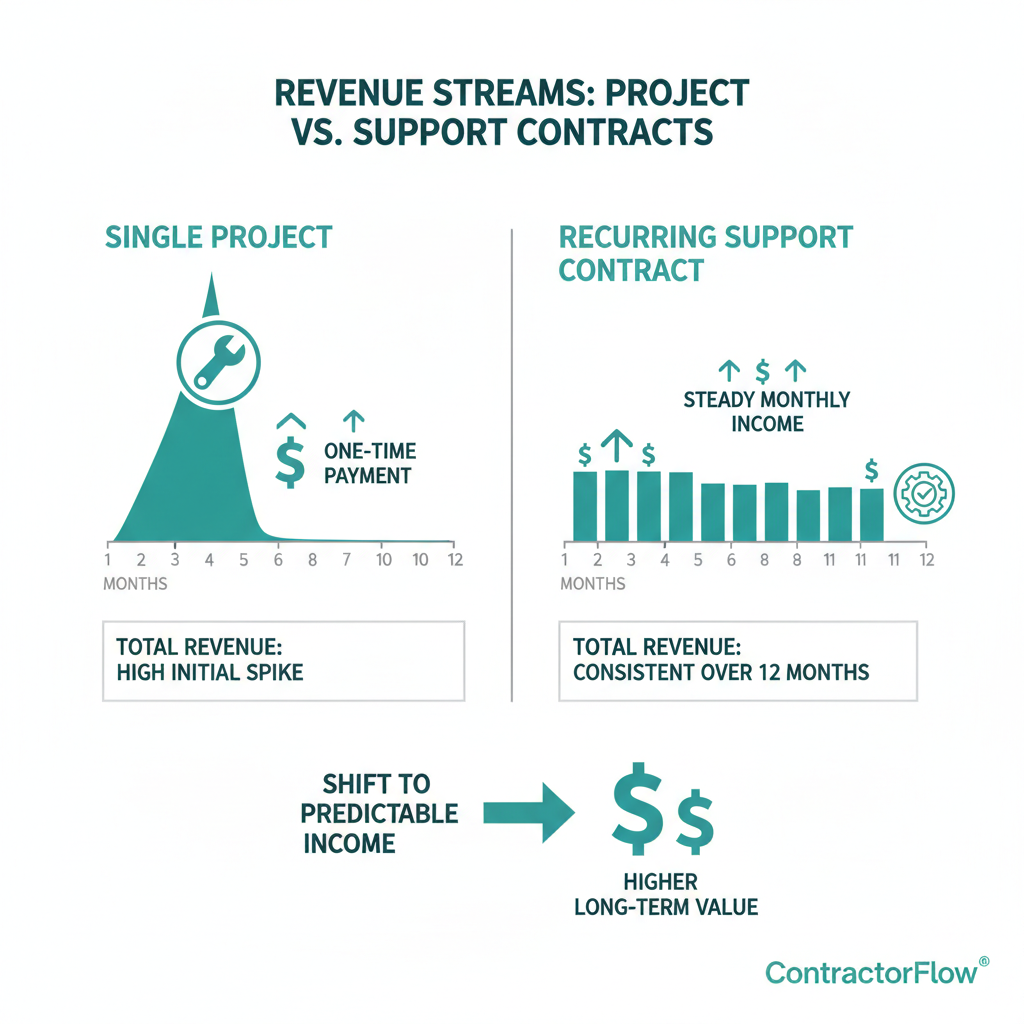
This shift from project-based work creates predictable monthly revenue, improving cash flow and increasing your company’s value. Without it, contractors often face:
- Scope creep eating into profit margins
- Unclear payment terms causing cash flow problems
- Disputes over what services were “included”
- Clients who disappear after the initial project
The solution? A well-structured ongoing support contract that sets clear expectations, protects both parties, and creates a foundation for long-term relationships.
Just as a construction company might build a facility and then provide maintenance, home service pros can install an HVAC system and then maintain it quarterly. These agreements can be simple or detailed, but the key is choosing the right structure for your services.
I’m Anna Lynn Wise, and after fifteen years in the trades, I’ve seen how these contracts transform businesses. At Contractor In Charge, we help home service pros implement the backend systems—from call handling to financial reporting—that make these long-term contracts profitable and sustainable.
What is an Ongoing Support Contract?
Think of an ongoing support contract as a marriage, not a first date. You’re committing to a long-term relationship with your client, providing service through seasonal tune-ups and unexpected emergencies. At its core, it’s a continuing services agreement where you agree to provide specific services to a client over an extended period.
Instead of a one-time fix, you provide regular check-ins, catching problems early and becoming a trusted partner who knows the client’s home inside and out. You’re not just a stranger who fixed something once; you’re the expert they rely on.
This principle works beautifully in home services. You installed the HVAC system or rewired the electrical panel, so you know that home better than anyone. Why wouldn’t the homeowner want you to be the one maintaining it?
For ongoing support contract contractors, these agreements often look like:
- HVAC maintenance plans for seasonal check-ups and tune-ups.
- Plumbing service agreements for annual inspections and priority response.
- Electrical safety check retainers for periodic panel and outlet testing.
These plans shift your business from reactive to proactive. Instead of waiting for something to break, you’re already on the calendar as the trusted expert.
More info about our Operations services
Key Differences from Other Contract Types
Knowing your contract types is essential:
- Project-based contracts have a clear finish line, like a furnace installation. Once the job is done, the contract is complete.
- Time and materials contracts are flexible, billing for hours worked plus materials. They are great for troubleshooting but focus on immediate problems, not continuous care.
- Fixed-price contracts offer a single price for a defined scope, giving clients cost certainty but are still built around completing a specific task.
The key difference with ongoing support agreements is right in the name: ongoing. They aren’t about finishing a project; they’re about establishing a rhythm of regular service and building a relationship.
Common Industries and Scenarios
While we focus on home services, these agreements are common elsewhere. In HVAC, plumbing, and electrical work, they are a natural fit. They offer homeowners reliability and predictable costs while giving you recurring revenue—a true win-win.
Commercial facility management also relies heavily on these agreements to ensure their buildings and systems run smoothly without having to manage multiple vendors.
Ongoing support contracts are about building long-term business relationships. You become their contractor—the first person they call and recommend. This transforms your business from a scramble for jobs into a stable company with recurring revenue you can count on.
Essential Components of a Support Contract
An ongoing support contract is the roadmap for your client relationship. It builds trust, protects your business, and prevents future disputes about what was “included.” A clear contract also helps you manage resources, plan schedules, and avoid unpaid extra work, directly impacting your bottom line.

Ways to Reduce Your Startup’s Operating Expenses Contractor in Charge
Scope, Deliverables, and Service Levels (SLAs)
This is where you spell out your promises.
- Define included services with specifics. For an HVAC plan, list “two annual preventative maintenance visits,” “coil cleaning,” and “filter replacement (customer-provided filters).” Detail matters.
- State exclusions clearly. If major repairs aren’t covered under the base fee, the contract must say so to prevent misunderstandings.
- Service Level Agreements (SLAs) define your response times. For example, guarantee a two-hour response for emergencies and two business days for standard calls. Be realistic and consistent.
- Define out-of-scope work to prevent scope creep that eats into profits. Be open to negotiating deliverables, but ensure your pricing reflects any customized services.
Payment Terms, Duration, and Renewal
Clear payment terms keep business relationships professional.
- A retainer fee model (monthly or annual payments) provides predictable cash flow for you and budget certainty for clients.
- Alternatively, use per-incident charges or a hybrid model (a retainer for maintenance plus discounted rates for repairs).
- Set a clear contract term length (typically one year) and include an auto-renewal clause. This states the contract continues for another term unless one party gives written notice (e.g., 30-60 days before expiration), simplifying long-term relationships.
- Specify termination conditions, including required notice periods and any final obligations.
Outsourced Accountants Can Help You Find The Profit In Your Company
Liability, Warranties, and Dispute Resolution
This section is your safety net for when things go wrong.
- Limitation of liability clauses cap your financial risk, protecting your business from potentially devastating claims.
- Clearly state any warranties on parts and labor to build client confidence.
- Indemnity provisions fairly allocate risk. For instance, they can protect you from claims if a system fails because a client ignored your maintenance recommendations.
- Establish a dispute resolution process in the contract (e.g., conversation, then mediation) to provide a clear, unemotional path forward if disagreements arise.
Getting these administrative details right is part of running a professional operation, but it can be a major time sink.
Simplify Your Beneficial Ownership Information (BOI) Filing with Contractor in Charge
Strategic Advantages for Ongoing Support Contract Contractors
The difference between a struggling contractor and a thriving one is often predictability. Chasing jobs leads to panic; ongoing support contracts provide stability.
Ongoing support contract contractors who use this model gain predictable revenue streams. Knowing your baseline income months in advance improves cash flow and allows you to plan for growth. A strong portfolio of recurring contracts also dramatically increases your business valuation, as potential buyers will pay a premium for a reliable income stream.
Financially, these contracts lead to improved client retention and reduced marketing costs. Keeping a client is far cheaper than finding a new one. The Project Management Institute found that 11.4% of resources are wasted due to poor processes, including contract management. Well-structured contracts directly attack this waste.
Elevating Efficiency
Fostering Successful Long-Term Relationships
With ongoing contracts, you shift from a one-time fixer to a trusted advisor. Proactive service prevents disasters. You replace an aging water heater before it floods the basement, saving clients stress and money, and they remember who made it possible.
With each visit, you understand client needs deeply, gaining institutional knowledge that makes you irreplaceable. This trust creates natural opportunities for upselling. Recommending an upgrade during a tune-up is seen as helpful advice, not a sales pitch.
Potential Risks and How to Mitigate Them
While powerful, these contracts have challenges that require a clear strategy.
- Scope creep: This silent profit killer starts with small, unpaid requests. Mitigation: Be ruthlessly clear in your contract about what’s included. For extras, politely say, “I’d be happy to quote that separately.”
- Underpricing services: A common trap when you’re eager to land a contract. Mitigation: Calculate your true costs—including labor, overhead, and fuel—and price accordingly. Review your pricing annually.
- Managing client expectations: Some clients will assume everything is included. Mitigation: Over-communicate during onboarding. Walk them through the contract and provide clear examples of what is and isn’t covered.
- Ensuring profitability: Not all contracts are equally profitable. Mitigation: Track your actual costs per contract. Use that data to refine your offerings and pricing.
- Resource allocation challenges: Scheduling can get complex as you grow. Mitigation: Use robust scheduling and dispatching systems to stay organized and prevent missed appointments.
This is why many successful contractors partner with services like Contractor In Charge. We handle your calls, scheduling, and admin, freeing you to focus on service delivery and keeping your technicians profitable in the field.
Managing the Contract Lifecycle Effectively
For ongoing support contract contractors, contract management is a continuous process, not a one-time task. Like the equipment you service, it requires regular attention to ensure everything runs smoothly and prevents problems.

A streamlined process is essential for consistency and efficiency. Technology like CRM and scheduling software is no longer a luxury; it’s a necessity for staying organized and competitive.
How To Select A CRM Scheduling Software
Stages of Project Contract Management
Every contract moves through four distinct stages:
- Ideation and Creation: Define your support plans, the services included in each, your contract terms, and your pricing structure.
- Negotiation and Execution: Present the agreement, work with the client to customize it to their needs, and get it signed. This stage is about building a partnership.
- Ongoing Management and Monitoring: This is the daily work of scheduling services according to your SLAs, tracking performance, and managing any changes. Good record-keeping and contract management software are crucial here.
- Evaluation and Renewal/Close-out: As the term ends, assess client satisfaction and profitability. Based on this, move to a seamless renewal (ideally with an auto-renewal clause) or formally close out the agreement.
Best practices for ongoing support contract contractors
Successful contract management comes down to a few key practices:
- Clearly define roles and responsibilities. To prevent confusion, know who handles scheduling, service, client communication, and renewals. A simple RACI (Responsible, Accountable, Consulted, Informed) framework can help.
- Create a deliverables timeline. Even ongoing contracts have recurring obligations. Integrate a timeline for routine visits and inspections into your scheduling system to ensure nothing is missed.
- Identify and plan for risks. Anticipate potential issues like scope creep, technician availability, or payment delays. Build appropriate contingencies into your contracts and operational plans.
- Use contract management tools for tracking. Automated Contract Lifecycle Management (CLM) software tracks key dates, stores documents, and monitors compliance. This automation reduces errors and frees up your time.
Use AI to Supercharge Your Contracting Success
Differentiating Types of Ongoing Support Contracts
Not every client needs the same level of support. Offering different tiers can meet various needs and budgets.
A simple support agreement is a basic plan covering limited, routine preventative maintenance (e.g., one or two visits per year) with standard response times. It’s ideal for budget-conscious clients and serves as an excellent entry point to build a relationship.
A comprehensive support agreement is a premium plan offering more, including extensive maintenance, priority service, diagnostics, and discounts on parts or labor. Response times are faster, sometimes with 24/7 emergency service included. This is perfect for clients who value maximum protection and predictable budgeting, which leads to stronger loyalty and retention.
The key is matching the right agreement type to each client’s situation. When you listen carefully and present options that make sense for them, everybody wins.
Frequently Asked Questions about Ongoing Support Contracts
We understand that diving into structured ongoing support can bring up a few questions. Here are some of the most common ones we hear from fellow contractors.
What is the difference between a continuing services agreement and a more comprehensive support agreement?
A continuing services agreement is the foundational contract for any ongoing work. A more comprehensive support agreement is a specific type of that agreement that includes a wider range of services, more detailed SLAs, and extra benefits like priority service or discounts on repairs. The choice between them depends entirely on the client’s needs and your service offerings.
What are the biggest benefits of these contracts for a home service business?
The primary benefits are transformative:
- Predictable, Recurring Revenue: This establishes a steady income stream, which makes financial planning, budgeting, and growth much easier.
- Increased Customer Loyalty and Retention: When clients are under contract, they are far less likely to call a competitor. This builds trust and reduces your customer acquisition costs.
- Improved Operational Efficiency: With scheduled maintenance visits, you can optimize routing and manage workloads more effectively, shifting your business from reactive to proactive.
How can I manage multiple support contracts without getting overwhelmed?
Managing multiple contracts is entirely achievable with the right approach:
- Standardized Templates: Develop clear, consistent contract templates for different service levels to save time and reduce errors.
- Clear Processes: Establish well-defined internal processes for everything from client onboarding to service scheduling, billing, and renewal reminders.
- Leverage Technology: This is the most crucial step. Use robust CRM and contract management software to automate reminders, track service history, and manage renewals.
At Contractor In Charge, we understand this challenge. Our systems, like Contractor in Charge Artificial Intelligence Dispatching and Scheduling, are designed to help automate these critical backend operations, so you can focus on providing top-notch service.
Conclusion
For ongoing support contract contractors, the shift from chasing individual jobs to building lasting partnerships requires a solid foundation: the continuing services agreement. We’ve covered the essentials: clear scopes to prevent misunderstandings, payment terms to protect cash flow, and liability clauses to safeguard both parties. This framework allows you to deliver consistent, quality service.
The strategic benefits are clear. Predictable income ends the feast-or-famine cycle, allowing you to plan, invest, and increase your company’s value. Clients stay longer, which reduces marketing costs. Effective management relies on standard templates, clear processes, and leveraging technology like CRM software to track dates and automate reminders.
While pitfalls like scope creep and underpricing exist, the strategies we’ve outlined make them manageable challenges rather than deal-breakers. Building a resilient home service business is about working smarter, not harder. These contracts shift your focus from reactive firefighting to proactive prevention, making you the expert clients trust.
At Contractor In Charge, we know your expertise belongs in the field, not buried in administrative tasks. While you build client relationships and deliver the exceptional service that sets you apart, let us handle the backend. From 24/7 call answering to scheduling, dispatch, and bookkeeping, we provide the support you need to build the sustainable, profitable business you deserve.
Streamline your business with Virtual Customer Service