

Decoding 1099 for Contractors: Forms, Taxes, and Self-Employment


Why Understanding 1099 for Contractors Matters for Your Business
1099 for contractors refers to the IRS forms businesses use to report payments to independent contractors. If you paid a contractor $600 or more for services in a year, you must file Form 1099-NEC by January 31st and give a copy to the contractor. Failure to file can lead to penalties from $60 to $660 per form.
Quick Answer: What You Need to Know
- Form 1099-NEC reports nonemployee compensation of $600 or more
- Deadline: January 31st for filing with the IRS and providing copies to contractors
- Your responsibility: Collect Form W-9 from contractors before paying them
- Contractor’s responsibility: Report income and pay 15.3% self-employment tax
- Penalty for non-filing: $60 to $660 per form depending on how late
As the gig economy grows, home service businesses increasingly hire contractors for specialized work, making 1099 compliance more critical than ever.
Getting 1099 for contractors right is about more than avoiding IRS penalties. It involves correctly classifying workers, understanding tax obligations, and maintaining accurate financial records. Misclassifying an employee as a contractor can lead to back taxes, penalties, and lawsuits.
I’m Anna Lynn Wise, an industry veteran who has managed 1099 for contractors as a business owner. At Contractor In Charge, we handle these backend tasks for service companies like yours, so you can focus on your trade.
Employee vs. Contractor: Getting Classification Right
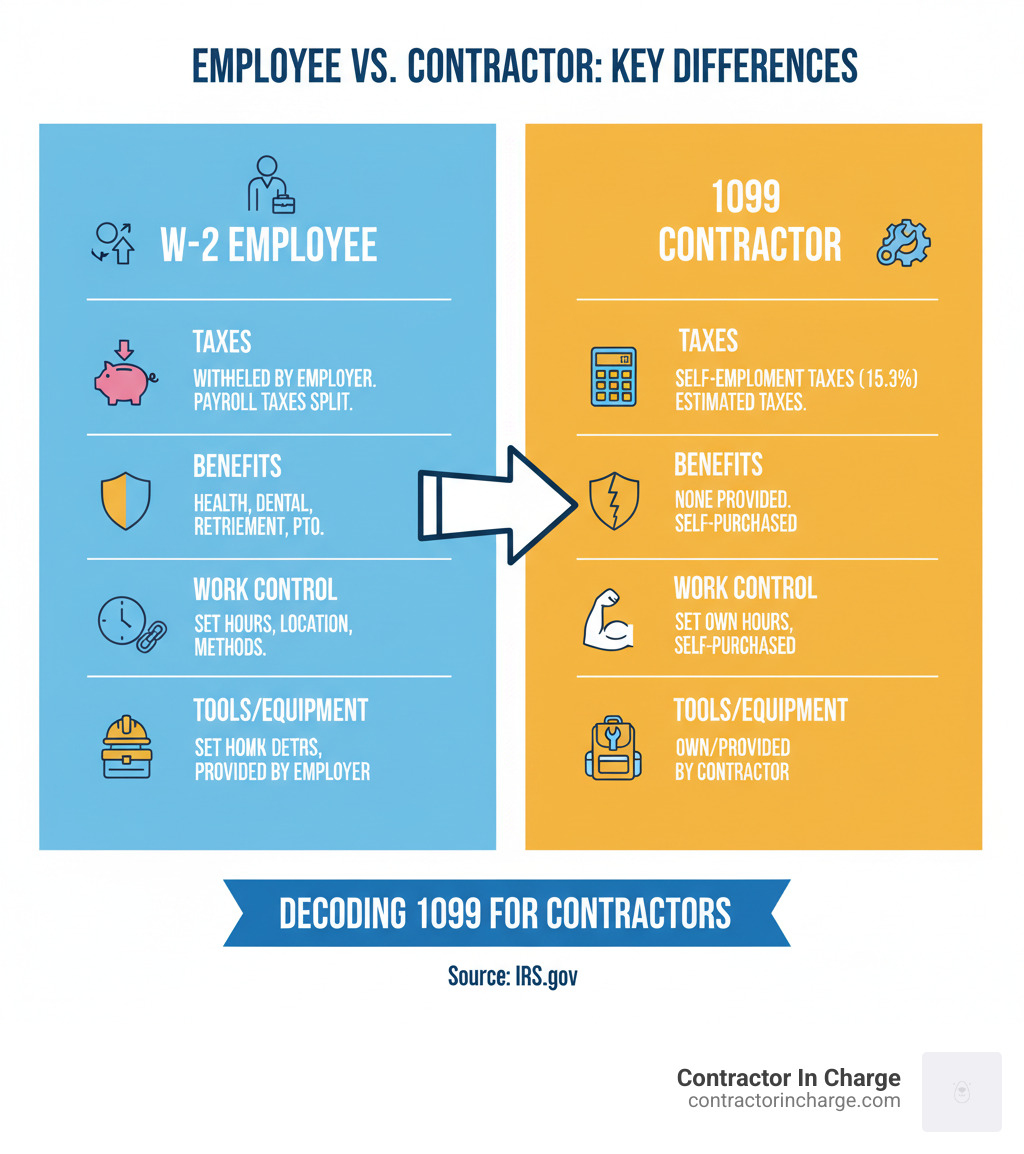
Understanding the difference between a W-2 employee and an independent contractor is the foundation of managing 1099 for contractors correctly. This distinction carries serious legal and financial weight. Getting worker classification wrong can lead to costly financial penalties and lawsuits, including back taxes and benefit repayments.
A W-2 employee works under your direct control. You set their hours, dictate their methods, and provide their tools. You also withhold taxes, provide benefits, and pay employment taxes. An independent contractor is a self-employed individual hired for specific projects. They use their own tools, set their own schedules, and control their work methods. You don’t withhold taxes or provide benefits; instead, you report their payments on a Form 1099.
If you’re unsure about a worker’s status, you can file Form SS-8 with the IRS for an official determination.
Let’s break down the key differences:
FeatureW-2 Employee1099 ContractorControlHigh—you dictate how, when, and where work gets doneLow—contractor controls their own methods and scheduleTaxesYou withhold income, Social Security, and Medicare taxes; you also pay the employer share of FICA and unemployment taxesYou don’t withhold anything; contractor pays all their own self-employment taxesBenefitsTypically offered (health insurance, retirement, paid time off)Not offered; contractor handles their own benefitsTools/EquipmentUsually provided by your businessUsually provided by the contractorLongevityOngoing, long-term relationshipProject-based, temporary, or task-specificLiabilityYour business is generally liable for their actions within their job scopeContractor is generally liable for their own actionsWorkers’ CompCovered by your workers’ compensation insuranceNot covered; contractor needs their own insurance
How the IRS Determines Worker Status
The Internal Revenue Service (IRS) looks at three categories to determine the degree of control in your relationship with a worker based on common law rules.
- Behavioral control: Does your business have the right to direct and control how the worker does their job? This includes instructions and training. An employee is told how to do the work; a contractor uses their own methods.
- Financial control: Who controls the business aspects of the job? This covers how the worker is paid, whether expenses are reimbursed, and who provides tools and supplies. A contractor has a significant investment in their own equipment and can realize a profit or loss.
- Type of relationship: How do you and the worker perceive the arrangement? This includes written contracts, benefits, the permanency of the relationship, and whether the services are a key aspect of your business.
You must weigh all three factors, as it’s rarely a clear-cut decision.
What is a “1099 Employee”?
The term “1099 employee” is a misnomer; no such classification exists with the IRS. A worker is either a W-2 employee or a 1099 independent contractor. People using this term are referring to an independent contractor. A 1099 employee is a contractor, not an employee. Using the correct term, independent contractor, avoids confusion and potential legal issues from misclassification.
Pros and Cons of Hiring Contractors vs. Employees
Deciding between a contractor and an employee is a strategic choice.
Hiring Independent Contractors:
- Pros:
- Flexibility: Easily scale your workforce up or down with demand.
- Specialized Skills: Access expert knowledge for specific projects without long-term training costs.
- Cost Savings: No employment taxes, benefits, or workers’ comp premiums. Reduced administrative burden.
- Cons:
- Less Control: You cannot dictate the contractor’s methods or schedule.
- Lower Integration: Contractors may have less loyalty and integration into your company culture.
- Misclassification Risk: Getting the classification wrong leads to significant penalties. Some businesses are exploring ways of including independent contractors in benefit plans to attract talent, but this must be done carefully.
Hiring W-2 Employees:
- Pros:
- Greater Control: You direct the work, hours, and methods, ensuring quality and consistency.
- Loyalty and Culture: Employees are more likely to be invested in your company’s long-term success.
- Training Investment: You can develop a skilled workforce that grows with your business.
- Cons:
- Higher Cost: You must pay employment taxes, benefits, and insurance. Businesses with W-2 employees must withhold part of Social Security and Medicare taxes and pay a matching amount.
- Less Flexibility: Hiring and firing involve more legal and HR considerations.
- Administrative Burden: More paperwork and compliance management is required.
Many home service businesses use a hybrid model: employees for core services and contractors for specialized or seasonal work.
A Business Owner’s Guide to 1099 for Contractors
Once you’ve correctly classified your workers, managing 1099 for contractors is an essential backend task to keep your business compliant. For every contractor paid $600 or more in a year, you have a responsibility to collect information, file the right forms, and provide copies on time.
Good record-keeping throughout the year makes this process much easier than scrambling in January. These rules also apply to any subcontractors you hire.
Common Forms and How to File Them
For most home service businesses, only a few IRS forms are relevant for contractors.
- Form W-9: Collect this before paying a contractor. It provides their legal name, address, and Taxpayer Identification Number (TIN). Keep it on file for at least four years.
- Form 1099-NEC: This is the primary form for reporting nonemployee compensation. Use it if you paid a contractor $600 or more for services during the year.
- Form 1099-MISC, Miscellaneous Information: Use this for other payments, such as rent ($600+), royalties ($10+), or prizes and awards ($600+).
- Form 1096: This is a summary cover sheet required only if you mail paper copies of your 1099s to the IRS. It’s not needed for electronic filing. You can order free hard-copy 1099-MISC forms from the IRS if needed.
The IRS encourages electronic filing, and it’s mandatory if you’re filing 10 or more information returns. You can use the IRS’s IRIS or FIRE systems, or compatible accounting software. At Contractor In Charge, our bookkeeping services include managing this process for our clients.
Key Filing Deadlines and Penalties
Missing 1099 for contractors deadlines can be costly.
- January 31st: This is the deadline to file Form 1099-NEC with the IRS and provide a copy to the contractor.
- Form 1099-MISC Deadlines: You must provide a copy to the recipient by January 31st. The deadline to file with the IRS is February 28th for paper filers and March 31st for e-filers.
Penalties for late filing increase over time, ranging from $60 to $660 per form. If the IRS determines you intentionally disregarded the filing requirement, the penalty is $660 per form with no maximum. These penalties are actively enforced and entirely avoidable with proper planning.
How to Fill Out Form 1099-NEC for Contractors
Accuracy is key when filling out Form 1099-NEC. Use the contractor’s Form W-9 as your guide.

- Payer’s Information: Enter your business’s legal name, address, and TIN.
- Recipient’s Information: Enter the contractor’s name, address, and TIN exactly as it appears on their W-9.
- Box 1: Report the total nonemployee compensation paid to the contractor for the year ($600 or more).
- Box 4: Report any federal income tax withheld. This is only for backup withholding situations.
- Boxes 5-7: Enter state tax information if your state requires it.
After completing the form, send Copy A to the IRS, give Copy B to the contractor, and keep Copy C for your records. Double-check all entries for accuracy before sending to avoid correction notices and penalties.
The Contractor’s Side: Tax Obligations and Self-Employment
If you work as an independent contractor, understanding your tax obligations is crucial. Receiving a 1099 for contractors means you are responsible for managing your own taxes as a self-employed individual.

This guide covers what to do when you receive a 1099-NEC, including how to report income and handle your tax burden.
Understanding Self-Employment Tax
The biggest surprise for new contractors is often the self-employment tax, which funds your Social Security and Medicare benefits. The rate is 15.3% of your net earnings (12.4% for Social Security up to an annual limit and 2.9% for Medicare).
Unlike a W-2 employee, whose employer pays half of these taxes, you are responsible for the full amount. Businesses with W-2 employees must withhold part of Social Security and Medicare taxes and match it, but as a contractor, you pay both halves. You are liable for this tax if your net earnings from self-employment are $400 or more. The good news is you can deduct one-half of your self-employment tax, which helps lower your adjusted gross income.
How to Handle Your Tax Obligations for 1099 for Contractors
When you receive a 1099 for contractors, follow these steps to report your income and pay taxes:
- Report Income and Expenses: Use Schedule C (Form 1040), Profit or Loss from Business, to report your gross income and deduct eligible business expenses (tools, materials, vehicle costs, etc.). This determines your net profit.
- Calculate Self-Employment Tax: Use Schedule SE (Form 1040) to calculate the self-employment tax you owe based on your net earnings from Schedule C.
- Pay Estimated Taxes: Since taxes aren’t withheld from your payments, you must make quarterly estimated tax payments to the IRS. Use Form 1040-ES, Estimated Tax for Individuals to calculate and pay these amounts if you expect to owe at least $1,000 in tax for the year.
Quarterly deadlines are typically April 15, June 15, September 15, and January 15 of the next year. Missing these can result in underpayment penalties. A common strategy is to set aside 25-30% of every payment you receive for taxes.
When are Taxes Withheld from a Contractor?
Generally, payers do not withhold taxes from payments to independent contractors. However, backup withholding at a flat rate of 24% is required in certain situations, such as:
- You fail to provide a correct Taxpayer Identification Number (TIN) on Form W-9.
- The IRS notifies the payer that your TIN is incorrect.
If taxes are withheld, the amount will be shown in Box 4 of your 1099-NEC, and you can claim it as a credit on your tax return. Another exception is for nonresident alien contractors, whose payments may be subject to a 30% withholding rate, though tax treaties can lower this. For most U.S. contractors with a valid W-9 on file, no taxes will be withheld.
Frequently Asked Questions about 1099s
We hear a lot of questions about 1099 for contractors from home service business owners. Here are the most common ones with clear, practical answers.
Do I need to file a 1099 for a subcontractor I hired?
Yes. If you hire a subcontractor and pay them $600 or more for services during the calendar year, you are the payer and must issue them a Form 1099-NEC. The same rules that apply to a large company hiring you apply to you when you hire others to help with your work.
What’s the main tax rate difference between 1099 contractors and W-2 employees?
The key difference is in Social Security and Medicare taxes.
- W-2 Employees pay 7.65% of their wages, and their employer pays a matching 7.65%. The total tax is 15.3%, split 50/50.
- 1099 Contractors pay the entire 15.3% self-employment tax themselves. They can, however, deduct the “employer” half (7.65%) on their tax return.
This self-employment tax is in addition to regular federal and state income taxes.
Do I have to issue a 1099 if I paid a contractor less than $600?
No. The IRS filing threshold for Form 1099-NEC is $600 or more in a calendar year. If you paid a contractor a total of less than $600 for the year, you are not required to issue them a 1099-NEC.
However, the contractor is still legally required to report all income to the IRS, regardless of whether they receive a 1099. Also, be aware that payments made through third-party networks like PayPal may be reported on a Form 1099-K by the payment processor, which is a separate requirement.
Conclusion: Streamline Your Contractor Payments and Bookkeeping
Managing 1099 for contractors is a critical part of running a compliant business. It starts with correct worker classification, continues with diligent record-keeping, and culminates in timely filing of Form 1099-NEC by the January 31st deadline. For contractors, it means understanding self-employment tax and making quarterly estimated payments.
As a home service business owner, your time is better spent on the job, not buried in paperwork. The administrative tasks of tracking payments and preparing 1099s can pull you away from the work that grows your company.
That’s why Contractor In Charge exists. We specialize in taking these backend tasks off your plate. Our bookkeeping services handle everything from tracking contractor payments to preparing your 1099 forms, ensuring you remain compliant without the headache. We combine smart technology with a dedicated team to support your business around the clock.
Gain peace of mind and focus on what you do best. Let us handle the paperwork, deadlines, and details. Don’t let the complexities of tax compliance slow you down. Reach out to Contractor In Charge today to simplify your contractor bookkeeping and see how much easier running your business can be.